
What does it mean to conduct grad-level work?
In undergraduate studies, many assignments focus on absorbing and repeating information—definitions, concepts, theories. You’re often evaluated on your ability to recall, summarize, or apply concepts in familiar contexts. Maybe stress about those series of deadlines you have throughout the months, and that one test you’ll take to finalize your grade.
Graduate-level work, by contrast, demands a deeper level of engagement; understanding is just surface-level in education. Taking what you have learned previously and applying it to your work and perhaps real-world situations is better. UDPF explores the differences between writing for undergraduate and graduate studies, focusing on citation and tone. “A graduate-level essay on the same topic would employ a formal tone, using terms like “the proliferation of social media platforms” and citing academic studies extensively to support arguments. It would also critically analyze the methodologies and findings of those studies.” (UDPF, 2024)
This means moving beyond merely understanding a theory to critiquing it, comparing it with others, and identifying its strengths, weaknesses, and practical applications. For example, instead of just summarizing what you may have learned, you may:
Compare the article’s framework to another theory.
Critically evaluate the research methodology.
Propose a new perspective based on your analysis.
Apply new methods to your work to create a product.
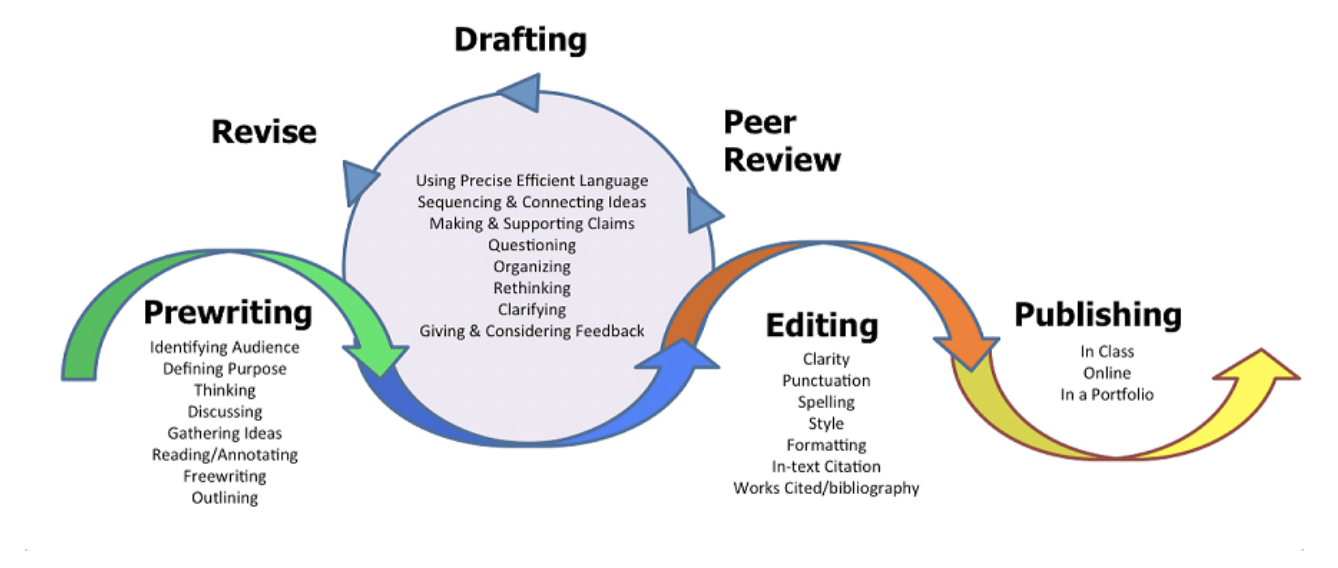
University of England (UNE Online Diagram)
The shift goes from asking the what and why to how you can contribute and evolve -shifting from a classroom setting to a real workforce setting.
Depending on the class, this process may look different. For design sprints, the process is broken up into phases with an emphasis on collaboration and communication -rather than working on your own, working with a team is recommended. This differs from another ICM class I had taken in the past, Writing for Interactive Media. In that class, collaboration is reduced to about 30%, and working solo is a priority. Similar to the diagram, peer review is essential in this class for clarity and understanding -does my article engage readers? Does it make sense?
It is interesting to see the focus shift from class to class from prioritizing creative writing to collaboration and prototyping. This evolution reflects the interdisciplinary nature of graduate-level work, where diverse skill sets are developed simultaneously to prepare students for real-world challenges. In one course, you may be honing your ability to craft compelling narratives or persuasive messaging, while in another, you’re building wireframes, testing user experiences, or working through team-based design sprints.
This constant shift pushes you to be adaptable, balancing individual creativity with group dynamics and practical application. It also highlights how interconnected these skills are—your ability to communicate an idea clearly can directly influence how well it’s executed in a prototype or received in a client pitch.
Over time, you begin to see that success in graduate school isn’t just about excelling in one area, but about integrating multiple competencies—writing, research, design thinking, strategy—into a cohesive and professional workflow.
I find that views on graduate-level work or higher education play a role in students' motivation and applications. It is less about turning in the assignment and more about preparing for the job force. According to the Pew Research Center, a survey was conducted comparing college and high school graduates and measuring their job satisfaction and career success. “While most workers say their education has been at least somewhat helpful on the job, fully 47% of college graduates 13 ages 25 to 32, report that their schooling has been “very useful” in getting them ready for a job or career.” (Pew Research Center, 2014)
To continue, the value of education has fluctuated over the years; priorities have shifted with changes in the world's social and economic status.
This Pew Research Center survey confirms what generations of parents have told their children: To get a good job, get a good education. At the same time, the findings suggest that the definition of a good education has changed in recent decades, with the rewards of education disproportionately concentrated among better-educated adults while those with less education are lagging far behind.” (PEW, 2014)
It is interesting to see these sentiments align with the current generation of graduates, especially since this specific study was almost 11 years ago. As a recent graduate myself who accelerated through undergraduate studies, I see it as the only choice. Of course, my program was specifically designed for graduating with both a bachelor's and master's degree within 4 years instead of the classic route of undergrad for 4 and however long (2+) for grad afterward, but my viewpoint has not changed since high school. Is there any other choice besides college? Besides pursuing a degree in search of a stable life in the future?
The sentiment of finding a good education and major to succeed in life is outdated and, frankly, feeds into the narrative that follows a linear, traditional path. It reinforces the idea that if you simply pick the “right” major and attend the “right” school, everything will fall into place—a notion that’s increasingly disconnected from the world we live in. In reality, success today looks much more dynamic. It’s not just about what degree you have, but how you apply your knowledge, how adaptable you are, and whether you can think critically, communicate effectively, and navigate change.
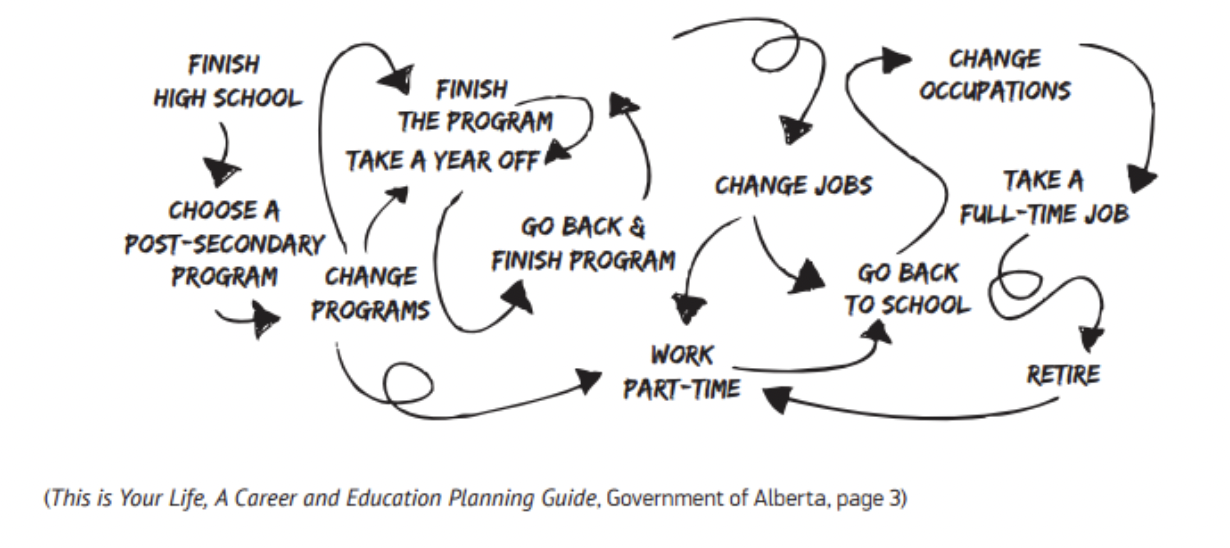
this is your life illustration
as someone who moved quickly through the transition of high school (during a pandemic) to out-of-state college, through both undergraduate and now graduate studies, I can see how many of us -especially Gen Z students -view education less as a golden ticket and more as a stepping stone. We recognize that degrees alone don’t guarantee job security or personal fulfillment, but they do offer tools, networks, and opportunities to grow in the right direction—if we use them wisely. The pressure to have everything figured out by the time you graduate, or to follow one specific trajectory, feels more like a relic of a previous generation’s expectations.
The purpose of attending classes are beginning to feel more fulfilling with in-depth conversations about relevant topics and situations you may encounter in the workforce. Rather than memorizing terms or completing assignments just to earn a grade, there’s now a noticeable shift toward learning that feels applicable, engaging, and thought-provoking. Discussions are no longer hypothetical—they’re grounded in real case studies, industry trends, ethical dilemmas, and social issues that impact how we work and communicate in today’s world.
This shift is especially apparent in graduate-level courses, where faculty often bring professional experience into the classroom, bridging the gap between theory and practice. It’s not uncommon to walk away from a class with insights into how to handle a tough client, lead a creative team, analyze user data, or navigate workplace communication breakdowns. These moments help solidify the idea that you’re not just studying for a test—you’re preparing for real-life scenarios you may soon face.
It’s also incredibly rewarding to be surrounded by peers who take the material seriously and contribute their own unique perspectives. Whether someone has worked in the field before, is switching careers, or is part of an accelerated program, everyone brings something valuable to the conversation. This diversity of thought leads to richer discussions and challenges you to think more critically. It’s in these moments—where ideas are exchanged freely, and perspectives are challenged—that learning becomes genuinely exciting again.
According to a Forbes article by Caroline Castrillon, non-linear careers are the future. “Non-linear career paths allow you to structure your professional life around what truly matters, enabling pivots toward work that feels meaningful.” (Caroline Castrillon, 2025) The value of graduate-level work lies not in its promise of a job, but in its cultivation of agility, critical thought, and meaningful engagement with the world. It aids in the flexibility of what can rather than what should.
“I think what attracts us to the concept of a linear life is that we don’t have to put in much effort. But trying to live by other people’s frameworks often creates inner conflict. We all have a unique set of needs, values, and wants that evolve.” (Kemi Oyesiku, Medium 2023)
Work shouldn’t be linear. Design sprints aren’t linear; they change and continue to change over time. That’s natural, and that is the beauty of graduate-level work. Rather than focusing on the work itself (which should still happen) the focus is on the concepts, theories, and lessons that can be applied to real life situations you may find yourself in a couple of months or even years from now.
Rather than focusing solely on the output, which, of course, still matters, graduate programs emphasize the underlying why. You’re encouraged to unpack the frameworks and strategies behind what you’re doing, so when you’re faced with a similar problem months or years down the road, you’re not just repeating steps, you’re adapting based on context. Whether it’s learning how to build a campaign, prototype an app, or manage a team, the work is meaningful because it’s not confined to the classroom. It’s setting up ethics for how you’ll show up in your career and in the world.
This mindset shift is empowering. It frees you from feeling like every decision has to be perfect, and instead encourages you to take risks, test ideas, and learn from failure. In the same way a design sprint thrives on iteration, so does your growth as a graduate student. You’re allowed to be in progress. You’re expected to refine, evolve, and continue learning long after a class ends. And that’s what makes graduate-level work so powerful —it’s not about mastering one project but about building the mindset to handle whatever comes next.
Citations
Castrillon, Caroline. “Why Non-Linear Careers Are the Future of Work.” Forbes, 18 Mar. 2025, http://www.forbes.com/sites/carolinecastrillon/2025/03/18/why-non-linear-careers-are-the-future-of-work/.
Kemi Oyesiku. “A Nonlinear Life Is Just Life – Kemi Oyesiku – Medium.” Medium, 26 July 2023, medium.com/@inthetransitions/a-nonlinear-life-is-just-life-ecae28b2f9cd.
Pew Research Center. “Chapter 2: Public Views on the Value of Education.” Pew Research Center’s Social & Demographic Trends Project, 11 Feb. 2014, http://www.pewresearch.org/social-trends/2014/02/11/chapter-2-public-views-on-the-value-of-education/.
UPDF. “Undergraduate vs. Graduate Writing: Understanding Differences.” Medium, 23 Jan. 2024, updf.medium.com/undergraduate-vs-graduate-writing-understanding-differences-3022caf3ca46.
xykademiqz. “Musings on Grad-School Work Ethic.” Xykademiqz, 3 Nov. 2014, xykademiqz.com/2014/11/02/musings-on-grad-school-work-ethics/.
